Leave-one-variable-out diagnostics for distance-based variable importance
lovo_mdist.RdComputes leave-one-variable-out (LOVO) diagnostics for a distance specification. The function first computes the full dissimilarity matrix using [mdist()]. It then removes one predictor at a time, recomputes the dissimilarity matrix, and compares each leave-one-variable-out matrix with the full one.
Usage
lovo_mdist(
  x,
  response = NULL,
  ...,
  mds = FALSE,
  dims = 2,
  keep_dist = FALSE,
  cluster_k = NULL,
  cluster_methods = c("pam", "hclust", "spectral"),
  hclust_method = "average",
  spectral_sigma = NULL,
  spectral_nstart = 50,
  response_used = TRUE
)
Arguments
- x
A data frame or object coercible to a tibble. Rows are observations and columns are variables used to compute the dissimilarity.
- response
Optional response variable. It can be supplied as an unquoted column name or as a character string. When supplied and `response_used = TRUE`, it is passed to [mdist()] for response-aware distance construction. The response column is not treated as a predictor in the leave-one-variable-out loop.
- ...
Additional arguments passed to [mdist()], such as `preset`, `method_cat`, `method_num`, `commensurable`, or `interaction`.
- mds
Logical. If `TRUE`, compute classical multidimensional scaling diagnostics for the full and leave-one-variable-out dissimilarities. The default is `FALSE`.
- dims
Integer. Number of dimensions used by classical multidimensional scaling when `mds = TRUE`. Ignored when `mds = FALSE`.
- keep_dist
Logical. If `TRUE`, store the full dissimilarity matrix and all leave-one-variable-out dissimilarity matrices in the returned object.
- cluster_k
Optional integer. Number of clusters used when computing clustering-based LOVO diagnostics. If `NULL`, clustering diagnostics are not computed.
- cluster_methods
Character vector specifying the clustering methods used for clustering-based diagnostics. Possible values are `"pam"`, `"hclust"`, and `"spectral"`.
- hclust_method
Character string specifying the linkage method passed to [stats::hclust()] when `"hclust"` is included in `cluster_methods`.
- spectral_sigma
Optional numeric value for the Gaussian affinity bandwidth used by spectral clustering. If `NULL`, the default used by [spectral_dist()] is applied.
- spectral_nstart
Integer. Number of random starts used by the k-means step in spectral clustering.
- response_used
Logical. If `TRUE`, the response variable, when supplied, is used in the distance construction. If `FALSE`, the response column is removed before computing distances.
Value
An object of class `"MDistLOVO"`. The main results are stored in the `$results` field as a tibble with one row per left-out variable. The object also has print, summary, and autoplot methods.
Details
`lovo_mdist()` is useful for assessing how strongly each predictor contributes to a distance-based representation. A predictor is considered influential when removing it produces a large change in the dissimilarity matrix or an optional downstream representation, such as a multidimensional scaling configuration or clustering partition.
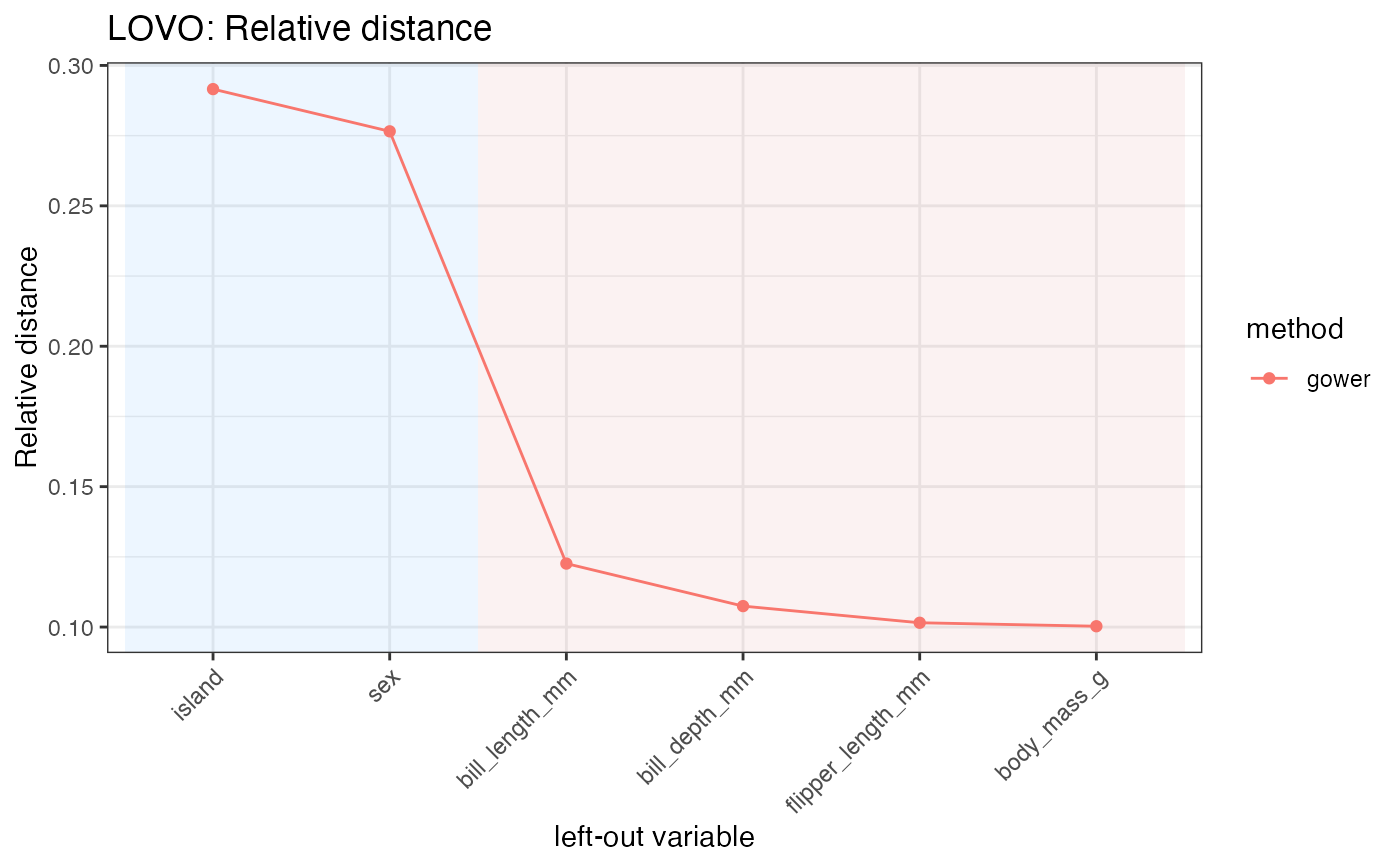
In `autoplot()`, `reorder = TRUE` ranks variables by the selected metric within each variable type, with categorical variables before numerical variables. This preserves the blue/red background bands. `top_n` selection remains global; without type information, ordering is global.
The returned object contains several LOVO diagnostics. The main distance contribution is measured by the mean absolute difference between the full dissimilarity matrix and each leave-one-variable-out matrix (`mad_importance`). The normalized version is stored as `relative_distance`.
If `mds = TRUE`, the function also compares classical multidimensional scaling configurations computed from the full and leave-one-variable-out dissimilarities. These diagnostics are stored as `mds_congruence` / `cc_importance` and `ac_importance`, the latter corresponding to an alienation coefficient. They are omitted when `mds = FALSE`.
If `cluster_k` is supplied, the function additionally computes clustering partitions from the full and leave-one-variable-out dissimilarities and compares them using the adjusted Rand index. The corresponding importance measures are defined as `1 - ARI` and are stored as `pam_importance`, `hclust_importance`, or `spectral_importance`, depending on the selected clustering methods.
Clustering-based diagnostics require the suggested package `mclust`.
Examples
if (requireNamespace("palmerpenguins", quietly = TRUE)) {
  data("penguins", package = "palmerpenguins")

  penguins_small <- palmerpenguins::penguins |>
    dplyr::select(
      species, bill_length_mm, bill_depth_mm, flipper_length_mm,
      body_mass_g, island, sex
    ) |>
    tidyr::drop_na()

  # Distance-based LOVO diagnostics for a Gower distance
  res <- lovo_mdist(
    penguins_small,
    preset = "gower",
    response = species,
    response_used = FALSE
  )

  res
  summary(res)

  # Plot the relative distance contribution of each predictor
  p <- res$autoplot(metric = "relative_distance")
  p
}
#> Summary of MDistLOVO
#>   preset : gower
#>   n_obs  : 333
#>
#> Relative distance:
#>   range [0.1003, 0.2916], mean 0.1667
#>
#> Top by relative distance:
#> # A tibble: 5 × 3
#>   variable          variable_type relative_distance
#>   <chr>             <chr>                     <dbl>
#> 1 island            categorical               0.292
#> 2 sex               categorical               0.277
#> 3 bill_length_mm    numeric                   0.123
#> 4 bill_depth_mm     numeric                   0.107
#> 5 flipper_length_mm numeric                   0.102
#>